Where to Find Authentic Punjabi Food in Bangkok (Honest Guide)
Most "North Indian" food in Bangkok is some version of Punjabi cooking — the heart of mainstream Indian cuisine. But what does "real Punjabi food" actually mean? And where, honestly, can you find it in Bangkok? Here's a guide written by someone who cooks it for a living.
What "Punjabi food" actually is
Punjab is the breadbasket of northern India — a region spanning India and Pakistan, with shared culinary roots that run deeper than the political border. Punjabi cooking developed around three things the land produced in abundance: wheat (for bread), dairy (from buffalo and cow milk), and seasonal vegetables (mustard greens, spinach, eggplant, okra, potatoes).
The cuisine has several hallmarks:
- Dairy-heavy gravies — yogurt, cream, fresh paneer, butter, ghee. The famous "makhani" (butter) sauces are Punjabi.
- Tandoor-cooked breads and meats — naan, kulcha, roti, tandoori chicken, kebabs. The tandoor (clay oven) is central to Punjabi kitchens.
- Slow-cooked lentils — Dal Makhani takes 8+ hours; Sarson da Saag is a winter staple simmered with mustard greens.
- Robust spicing — garam masala (cinnamon, cardamom, clove, black pepper, bay), Kashmiri chili powder for colour, kasoori methi (dried fenugreek) for aroma.
- Hospitality — Punjabi meals are abundant. A typical Punjabi dinner has 4-6 dishes plus bread, rice, dal, and lassi. Eating less is considered impolite to the host.
The five dishes that define Punjabi cooking
1. Butter Chicken (Murgh Makhani)
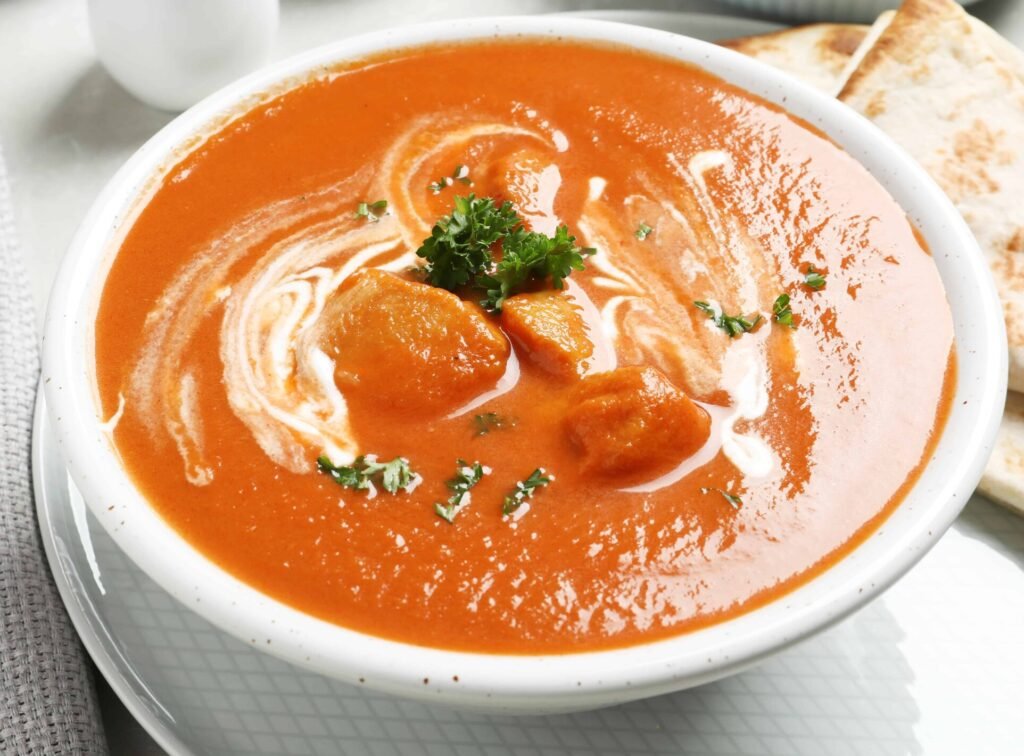
Invented at Moti Mahal in Delhi in the late 1940s. Tandoori chicken folded into a slow-cooked tomato-butter-cream gravy with kasoori methi. The most copied Indian dish in the world; rarely cooked correctly outside Punjab. We wrote about how to spot real butter chicken in Bangkok →
2. Dal Makhani
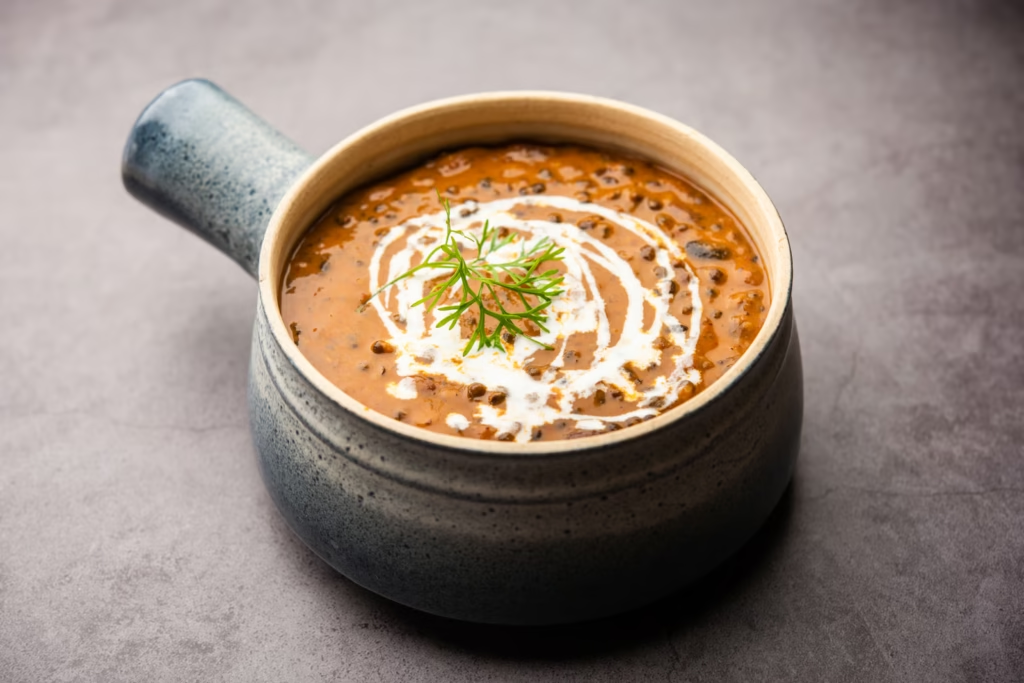
The other half of the Moti Mahal heritage. Whole black urad lentils and red kidney beans, soaked overnight, then slow-cooked for 8+ hours with butter, cream, and tomato. The texture should be silky, almost custard-like. This is the Punjabi dal — every other dal is faster, but none has this depth.
3. Sarson da Saag with Makki di Roti
Winter staple. Mustard greens (sarson) slow-cooked with spinach, ginger, garlic, and green chili, finished with butter. Served with makki di roti (corn flour flatbread) and dollops of fresh butter. Eaten across rural Punjab during the winter months. It is not on our menu — fresh mustard greens are hard to source in Bangkok, and we would rather say so than serve it with the wrong greens; Dal Makhani and Palak Paneer give the same slow, buttery comfort.
4. Tandoori Chicken
Chicken marinated overnight in yogurt, ginger, garlic, garam masala, and Kashmiri chili, then slap-cooked on the inside wall of a real charcoal tandoor at 480°C. The char marks and smoke aroma are the proof. Without a real tandoor, you cannot make real tandoori chicken — gas convection ovens cook the chicken but produce no smoke. Why charcoal matters →
5. Chole Bhature
Punjabi Sunday brunch. Spiced chickpea curry (chole) served with deep-fried puffed bread (bhature). Eaten with sliced raw onion, green chili, and pickled lime. A breakfast/lunch dish in Punjab, often served in roadside dhabas (truck stops).
Punjabi vs other North Indian styles
"North Indian" covers more than Punjab. Brief regional distinctions:
- Punjabi — robust, dairy-heavy, tandoor-centric. Butter chicken, dal makhani, paneer dishes, tandoori meats, naan and roti.
- Mughlai — refined court cuisine descended from Mughal-era kitchens. Korma, biryani, kebab, kheer. Heavy use of nuts, saffron, rosewater.
- Awadhi (Lucknowi) — slow-cooked, perfumed cuisine from Lucknow. Galauti kebab, biryani Lucknowi-style (yakhni, layered separately).
- Kashmiri — Persian-influenced. Rogan josh, yakhni, Kashmiri red chili (for colour, less heat).
- Pahari (mountain) — from Himachal and Uttarakhand. Simpler, less dairy-heavy. Madra, kadhi, bhatt ki churkani.
At BHARAT, the menu is primarily Punjabi (butter chicken, dal makhani, paneer dishes, tandoor section) with Mughlai mains (rogan josh, korma), some Awadhi influence in the biryani, and our Uttarakhand chef's Pahari roots showing up in subtle ways — slightly less cream in our makhani than typical Delhi versions, mustard oil used for some marinades, occasional Pahari dal preparations on the specials board.
Where to find authentic Punjabi food in Bangkok
Honest assessment of the Bangkok Punjabi food landscape:
What you'll find easily: "butter chicken" on virtually every Indian restaurant menu (most are pan-cooked chicken in generic tomato-cream sauce, not true makhani). "Tandoori chicken" cooked in gas tandoors (looks similar, tastes different). "Naan" from gas tandoors (cooks fine but loses the char). Generic "dal makhani" that hasn't been slow-cooked for 8 hours (it's a faster yellow-dal-with-cream impostor).
What's harder to find: Real charcoal-tandoor chicken with proper smoke. Dal makhani actually slow-cooked overnight. Paneer that is fresh and cooked soft rather than reheated twice. Authentic Sarson da Saag (very few Bangkok kitchens make it; harder to source fresh mustard greens). Real chole bhature for breakfast/brunch (rare in Bangkok).
BHARAT does the first three — real charcoal tandoor, overnight Dal Makhani, fresh paneer. Sarson da Saag is not on our menu — fresh mustard greens are hard to source here. Chole bhature is on the breakfast menu from 9 AM — two bhature with long-simmered chickpeas, ฿150; our Indian breakfast guide covers the rest of the morning plates.
What to order if you want a Punjabi meal at BHARAT
For a table of 2-3, the Punjabi-classic order:
- Starter: Tandoori Chicken (half) + Paneer Tikka (mixed grill)
- Main 1: Butter Chicken
- Main 2: Dal Makhani
- Main 3: Paneer Butter Masala or Palak Paneer
- Breads: 2x Butter Naan + 1x Garlic Naan + 1x Tandoori Roti
- Rice: Jeera Rice (optional, if you want rice on the side)
- Drinks: Mango Lassi or Salted Lassi
- Dessert: Gulab Jamun (warm, two pieces)
That's about ฿1500-2000 for two to three people sharing, plus drinks. The most representative spread of Punjabi cooking you'll find in Bangkok.
The bottom line
Real Punjabi food exists in Bangkok if you know where to look. Most restaurants serve Punjabi-inspired food adjusted for speed, scale, and Bangkok tastes. A small number — including us — cook it the slow way, with the right tools and the right ingredients. The difference is in the depth and the smoke. Once you've had real Dal Makhani after eight hours of slow cooking, the quick version tastes thin. Once you've eaten Butter Chicken whose chicken came off a real charcoal tandoor, the gas-grilled version tastes flat.
If you want to test the difference yourself, walk over from the Huai Khwang hotels — Grand Mercure Bangkok Atrium is two minutes — or take an 8-12 minute Grab from Asoke. We're open 9 AM to 11:30 PM every day, and the full Punjabi spread — tandoor, dal makhani, breads — is on the same menu at every service.
The Punjabi spread described above is all on our menu, and if you want the background to how this kitchen cooks it, our North Indian page is the longer version of the story.
More from BHARAT
If you want to read further, we go deeper into our Punjabi roots and what comes off the tandoor on their own pages.
Frequently asked
What is Punjabi food?
How is Punjabi food different from other North Indian food?
What is the most famous Punjabi dish?
Where can I get real Sarson da Saag in Bangkok?
Is your Punjabi food halal?
Continue reading
Best Butter Chicken in Bangkok: How to Tell Real Punjabi-Style From the Hotel Version
Butter chicken is the most ordered Indian dish in Bangkok — and the most often gotten wrong. Six markers that separate real Punjabi makhani from the generic version, plus where to find the real thing in Huai Khwang.
Read →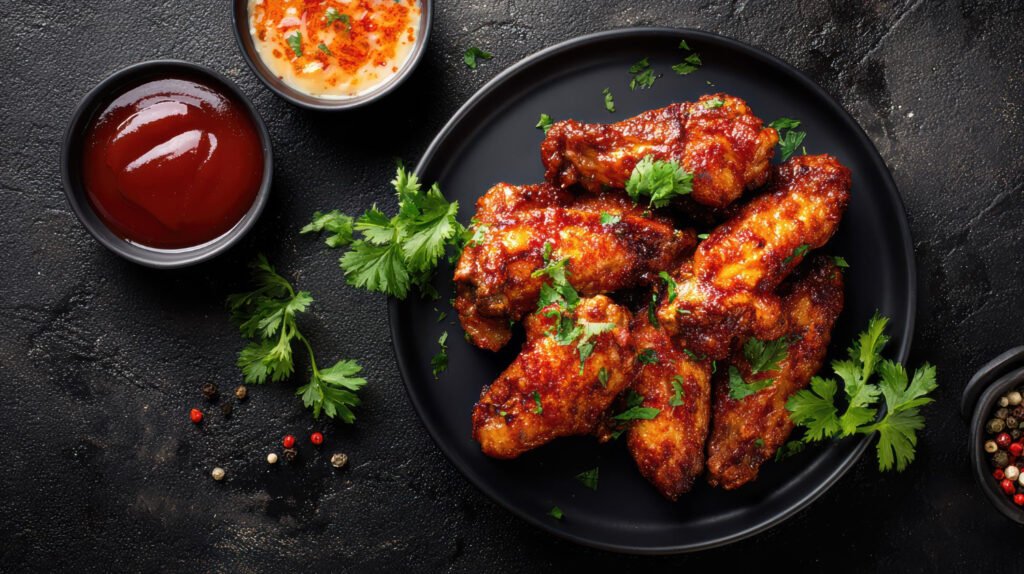
Real Charcoal Tandoor vs Gas: The 480°C Difference (And Why You Can Taste It)
Why we installed a real charcoal tandoor against every consultant's advice — and how 480°C clay-oven cooking is fundamentally different from a gas convection unit. Seven differences, three physics reasons, and eight dishes that need it.
Read →Come taste it for yourself
BHARAT Flavours Of India · Huai Khwang, Bangkok · 2 min from Grand Mercure · Open daily 9 AM to 11:30 PM