Halal Indian Food in Bangkok: How to Verify CICOT Certification at a Restaurant
If you are Muslim and traveling in Bangkok, finding a properly halal Indian restaurant is harder than it should be.
Most places will tell you they are halal. Far fewer can show you the certification. Even fewer can explain how their kitchen actually handles halal sourcing day to day.
We get asked about this constantly at BHARAT Flavours Of India in Huai Khwang. Hotel guests from Saudi Arabia, the UAE, Indonesia, Malaysia, and India ask the same questions before they sit down: where is your meat from, do you have certificates, do you cook with alcohol, do you have pork in the kitchen. The questions are fair. The answers should be straightforward.
Here is what halal certification actually looks like in Thailand, the four things to verify on packaging, the questions worth asking your server, and how we handle halal sourcing at BHARAT.
What CICOT actually is
CICOT is the Central Islamic Council of Thailand, the national body chaired by the Sheikhul Islam. Halal certification is administered through its Halal Standard Institute of Thailand together with the provincial Islamic committees. It is the official Thai government-recognized halal certification authority. CICOT inspects, certifies, and audits food producers in Thailand for halal compliance. Their certification is the standard recognized internationally for Thai halal food.
A CICOT-certified product carries:
- The official green halal logo issued by CICOT
- A certification number that can be checked against CICOT's records
- The expiry date of the certification
- The certifying body's name and seal
CICOT certification is renewed annually. It covers the production facility, the slaughter process, the supply chain from animal feed to final packaging, and the cleanliness of equipment used. The auditing process is thorough — CICOT inspectors visit production sites, review training documentation, and verify that no haram contamination has occurred at any point.
For meat specifically, CICOT certification means:
- The animal was slaughtered according to Islamic law (zabiha)
- A trained Muslim slaughterer performed the act with the intention and recitation
- The animal was healthy and not stunned in a way that contradicts Islamic law
- The blood was fully drained
- No pork, alcohol, or other haram substances were present in the slaughter or packaging facility
The four things to verify on packaging
If a restaurant tells you their meat is halal, you can verify it yourself in 30 seconds. Ask to see the packaging from the latest delivery. Then check four things:
1. The green CICOT logo. It looks distinct — a small green square or circle with Arabic and Thai script, and the word "Halal" in English. Generic green halal logos from non-Thai authorities are not the same. CICOT's logo is specific.
2. The certification number. Every CICOT certificate carries a number, and the number is the part you can actually check. Ask to see it, then verify it against CICOT's own records at halal.co.th rather than judging the certificate by how the number is formatted — formats change, and provincial Islamic committees issue under CICOT as well. A producer who cannot give you a number at all is the real warning sign.
3. The expiry date. Certificates are usually annual. Check the date — if expired, the certificate is no longer valid even if the logo is still on the packaging.
4. The producer name. It should match a known CICOT-certified producer. The two largest in Thailand for chicken are CP Foods and Betagro. Both have multiple CICOT-certified product lines (not all their lines are halal — check the specific package). Smaller halal-certified brands include Saha Farms, Cargill Meats Thailand, and several specialty producers.
If the package has all four — logo, number, valid date, recognized producer — the meat is genuinely halal.
Five questions worth asking your server
Before you sit down at any Indian restaurant in Bangkok claiming to be halal, ask:
1. "Where do you source your chicken and mutton?" The answer should be specific. "Makro" or "Lotus's", or a named halal supplier they can identify. Vague answers like "from a local market" should make you cautious.
2. "Is your meat CICOT-certified?" The answer should be yes, with confidence. If the server hesitates or says "I think so" or "I'm not sure," ask to speak to the manager.
3. "Do you cook with alcohol?" Real halal Indian kitchens use no cooking wine, no rum-based reductions, no alcohol-based extracts. We never cook with alcohol — nothing alcoholic ever touches the food. If a dish claims a "wine reduction" anywhere, it is not halal cooking. Ask specifically about cooking.
4. "Do you serve pork?" The cleanest answer is no — no pork in the kitchen, no pork in the menu, no possibility of cross-contamination. Restaurants that serve both halal and pork dishes typically segregate equipment, but the segregation is harder to verify.
5. "Can you show me the packaging?" A confident halal restaurant will not hesitate to show you a chicken or mutton package with the CICOT logo and number. If the server seems put off by the request, that itself is a signal.
How we source halal at BHARAT — and what we do not claim
Important up front: BHARAT itself is not formally CICOT-certified. The restaurant has not been through the formal CICOT restaurant-level audit. We describe ourselves as halal-friendly, not halal-certified. We would rather you know that exactly than have you assume otherwise. Here is everything we actually do.
Where: Fresh chicken, fish and vegetables come from Makro (Siam Makro) every morning; the bone-in goat comes from our halal supplier, also fresh daily. A daily delivery, not a weekly bulk order. The reason: fresher meat, better quality control, fewer storage variables.
What: We buy halal-marked product lines from Makro. Most of our chicken is from CP Foods halal lines (CP has both halal and non-halal product lines — we only buy the halal-marked ones). Some chicken is from Betagro, also on their halal product lines. CP and Betagro are poultry producers, so our bone-in goat is not theirs — it is halal-marked bone-in goat from our halal supplier. The supplier-level halal mark is what we rely on; we do not have an independent restaurant-level CICOT audit on top of that.
Verification: We keep packaging from the most recent delivery available for any guest who wants to verify. The supplier halal logos and brand names are visible on every pack. Ask any server and they will bring out the packs within five minutes.
Pork: No pork in the kitchen. No pork in the menu. No pork in any preparation, ever.
Cooking alcohol: Our chef does not use cooking alcohol. Some Indian dishes traditionally use a splash of brandy or rum (e.g., certain Goan preparations) — we do not make those dishes. Our menu is North Indian, where alcohol is not a traditional ingredient. To be straight with you: beer and wine are served at the table in the dining room, dine-in only, and they are kept away from the kitchen entirely.
Kitchen separation: All meat-handling utensils, cutting boards, pans and surfaces are used only for the halal-marked products we buy. There is no non-halal meat in the building to cross-contaminate with, and no pork has ever been through this kitchen.
Seating: Muslim guests with a seating preference are welcome to mention it when reserving — we have plenty of quiet seating, including the Dastarkhan floor-seating corner.
If you need formal restaurant CICOT certification: We respect that requirement. There are a small number of restaurants in Bangkok that hold the restaurant-level CICOT mark; we are not yet one of them. If that level of certification is essential for your visit, we want you to know upfront so you can choose accordingly.
Common myths
"Indian restaurants in Bangkok are halal by default." Not true. Some serve pork — Indo-Chinese and multi-cuisine menus are the usual place to find it — some cook with alcohol, and many source meat with no halal mark at all. Always verify.
"If they say halal, they are halal." Saying it does not make it true. Verify with the four packaging checks above.
"Halal-friendly is the same as halal." "Halal-friendly" usually means the restaurant takes some halal precautions but does not have full certification. "Halal" with documentation is different. Ask which one applies.
"All chicken in Thailand is halal." Most chicken in Thailand is processed at facilities that handle both halal and non-halal birds. Without specific CICOT-certified product lines, the chicken on your plate may not be halal.
The bottom line
If you are Muslim and want to eat properly halal Indian food in Bangkok, ask the five questions, run the four packaging checks, and be willing to walk if the answers are vague. The good restaurants will not be offended — they will be relieved that someone is checking.
We are 2 minutes walk from Grand Mercure Bangkok Atrium in Huai Khwang, and about 5 minutes by taxi from the Lancaster Bangkok on Sukhumvit 22. We serve over 200 North Indian dishes from a halal-friendly kitchen — halal-marked supplier ingredients, no pork, no cooking alcohol, with the honest caveat that the restaurant itself does not currently hold a formal CICOT certificate. Ask us anything when you visit.
Want to know more about how we cook? Read about our real charcoal tandoor and why our butter chicken tastes the way it does.
If the sourcing above answers your questions, the full menu shows which dishes use chicken, goat, fish or egg, and you can reserve a table or ask us anything on WhatsApp at +66 97 923 7281 before you come.
More from BHARAT
If you want to read further, we go deeper into how we handle halal sourcing and what comes off the tandoor on their own pages.
Frequently asked
What is CICOT halal certification?
Is BHARAT halal?
How can I verify a restaurant is actually halal?
Do you cook with alcohol?
Are halal-friendly and halal the same thing?
Continue reading
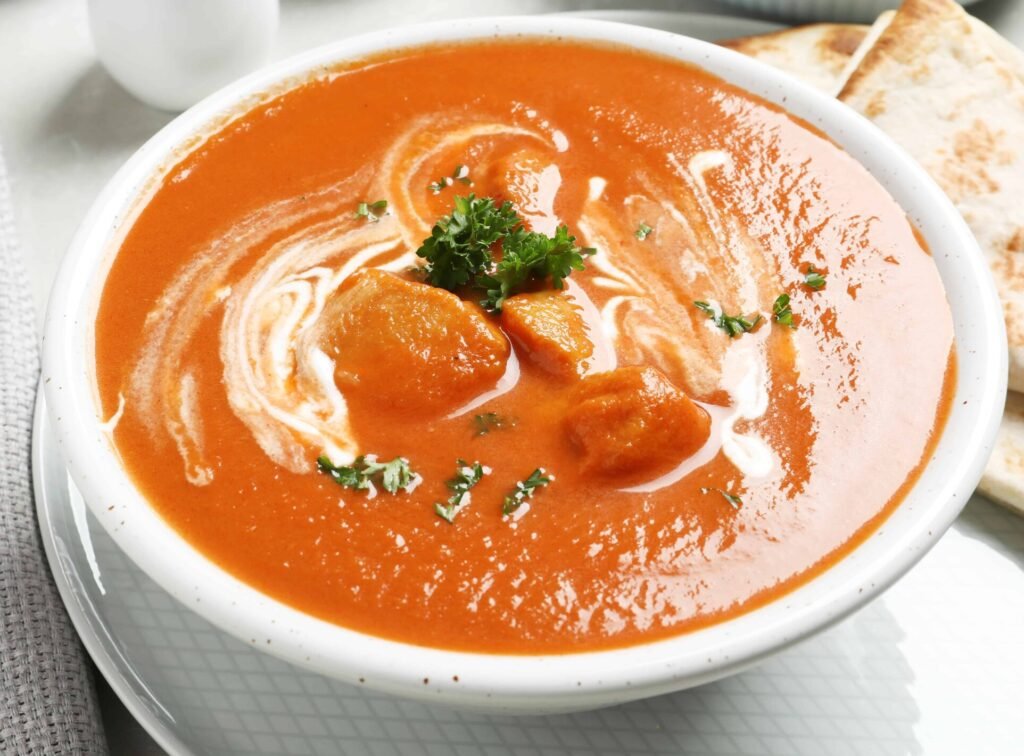
Best Butter Chicken in Bangkok: How to Tell Real Punjabi-Style From the Hotel Version
Butter chicken is the most ordered Indian dish in Bangkok — and the most often gotten wrong. Six markers that separate real Punjabi makhani from the generic version, plus where to find the real thing in Huai Khwang.
Read →
Real Charcoal Tandoor vs Gas: The 480°C Difference (And Why You Can Taste It)
Why we installed a real charcoal tandoor against every consultant's advice — and how 480°C clay-oven cooking is fundamentally different from a gas convection unit. Seven differences, three physics reasons, and eight dishes that need it.
Read →Come taste it for yourself
BHARAT Flavours Of India · Huai Khwang, Bangkok · 2 min from Grand Mercure · Open daily 9 AM to 11:30 PM